_FBlogo_red.png)



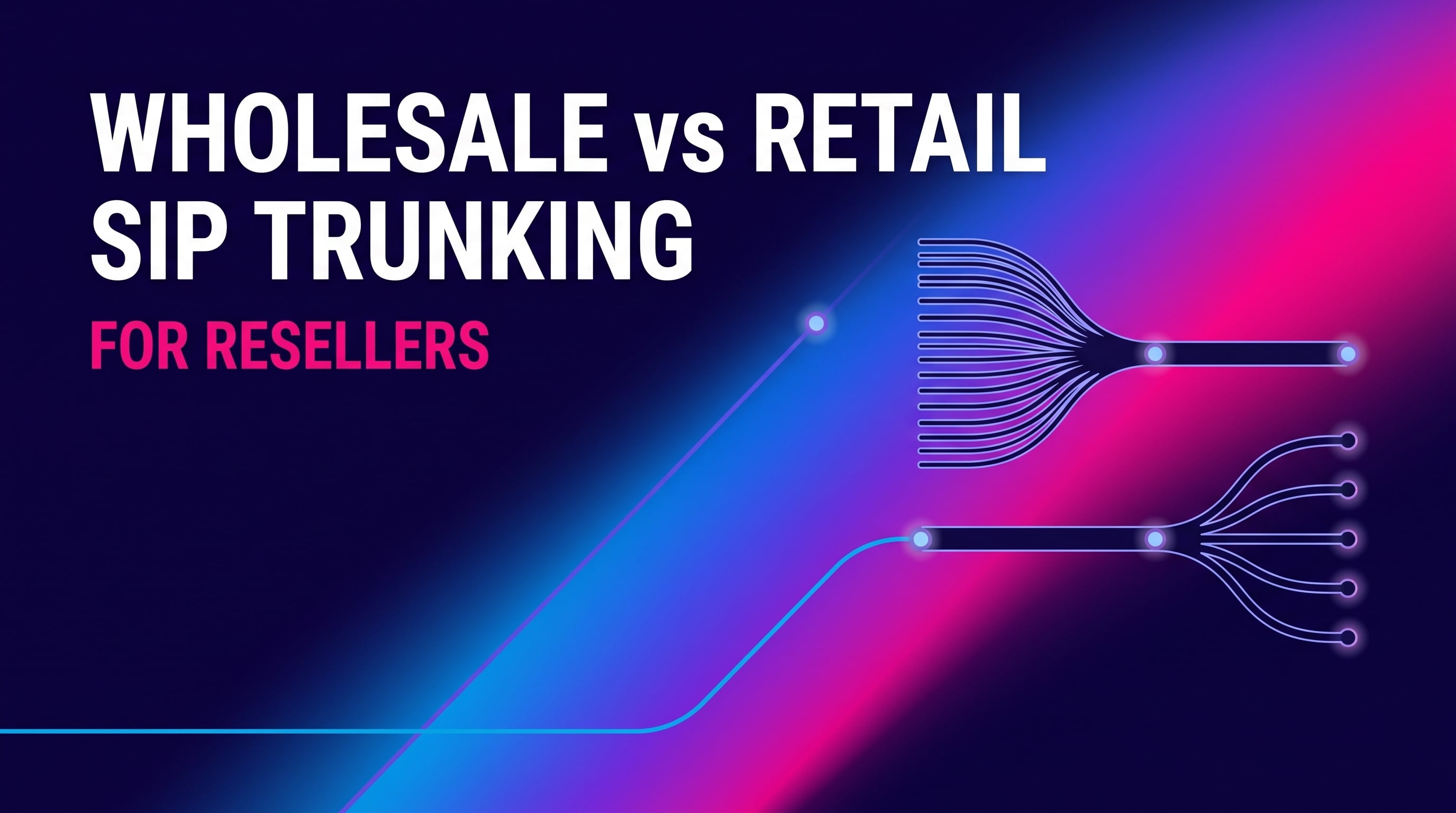
Wholesale SIP trunking and retail SIP trunking use identical technology — the difference is entirely about who's on the hook for billing, compliance, and support. Overlooked billing shifts from the provider to you; compliance issues like telecom tax and E911, and support challenges like number porting, can actually turn a good margin into a bad quarter.
For example, tax (USF, E911 fees, state surcharges) varies by jurisdiction and is easy to file wrong at scale; slow porting stalls onboarding and delays revenue; and E911 compliance carries real regulatory liability if a location isn't registered correctly. While none of these hidden costs will show up on a rate sheet, all of these can quietly erase the margin a good wholesale rate was supposed to protect. Here's how to spot these unseen costs before they eat into your margin.
Key Takeaways
-
Same tech, different responsibilities: retail and wholesale trunking work identically — what changes is who handles billing, tax, support, and E911.
-
Two limits, often only one is published: concurrent channels cap how many calls run at once, but calls-per-second caps how fast you can dial new ones — a dialer can hit the CPS speed limit even with channels to spare.
-
E911 liability can shift to you quietly: Kari's Law and RAY BAUM'S Act require direct 911 dialing and location data — confirm who registers and manages that before signing.
-
Wholesale's real cost is absorbed work, not the rate: the true cost of going wholesale isn't the per-minute rate you're quoted — it's the operational work (i.e., billing, tax filing, porting, and E911 registration) that used to be someone else's problem and is now yours.
Wholesale Versus Retail SIP Trunking
A trunk is simply a single connection carrying multiple simultaneous calls between a phone system and the public phone network. Wholesale means that capacity is bought in bulk at carrier rates, meant to be resold. Retail means it's sold directly to the business making the calls, one trunk at a time. Both deliver the same thing to your PBX: SIP trunks carrying calls over IP. What differs is the deal around them — who's buying, who's billing, and who's responsible for what.
| Retail SIP trunking | Wholesale SIP trunking | |
|---|---|---|
| Who buys it | The end user (i.e., the business making the calls) | A reseller, MSP, carrier, or platform |
| Pricing | Published, per trunk or per seat | Negotiated on committed volume |
| Who bills the end customer | The provider | You |
| Who answers the support call | The provider | You, in most agreements |
| Telecom tax and USF | Handled by the provider | Depends entirely on the agreement |
| Margin available to a reseller | Effectively none | The reason the model exists |
| Minimum commitment | Usually none | Common and negotiable |
A useful test: if you can sign up online with a card and without a conversation, you are buying retail. Wholesale involves a rate sheet and a conversation, because the provider is pricing your volume.
What to Check Before Signing a Wholesale SIP Agreement
1. Concurrent channels and calls per second
These are two separate limits, and providers don't always publish both. Concurrent channels cap how many calls you can run at once. Calls per second caps how fast you can dial new ones — which matters for outbound campaigns or a contact center. Size a trunk on channels alone, and it can still fail under a dialer.
2. Who is responsible for E911
This is the obligation that shifts most visibly when you move from retail to wholesale — your retail provider used to handle it for you. Two laws set the baseline: Kari's Law requires multi-line phone systems to let anyone dial 911 directly, no access code needed, and to alert an on-site contact when a 911 call goes out. RAY BAUM'S Act adds a requirement to provide a dispatchable location with that call. We cover both in more detail here.
For a wholesale buyer, the real question is simpler: does the provider handle address registration, per-location caller ID, and let you test it — or do they just hand you raw trunks and leave that obligation to you? Ask if you can dial 933 (or similar) to verify what caller ID and address would show up on a real 911 call.
3. Telecom tax and regulatory fees
Retail providers bake USF contributions, state surcharges, and E911 fees into the published price. Wholesale providers may not — because now you're the one selling to the end user. Who's responsible isn't standard practice, it's whatever the agreement says. Get the details in writing — who calculates, files, and remits fees — before you compare rates because the rate alone doesn't tell you the real cost until you know who's doing that work.
4. Number porting
Porting is where onboarding stalls, and the delay la on your reputation rather than the provider's. Ask for typical port timelines by number type, who manages rejections, and what happens to ported-in numbers if you leave.
5. Rate structure beyond the headline rate
Per-minute rates tend to look similar across providers, since they're quoted to be compared. The real differences show up elsewhere: billing increments, how interstate vs. intrastate calls are priced, whether unused minutes roll over, and how toll-free numbers are billed. Two providers can quote the same rate and still produce very different invoices.
SIP Trunk Providers to Compare in 2026
The right SIP trunk provider for you depends on whether you're building your own platform, running a business that just needs trunks, or looking for the operational layer already built for you. That's why we've grouped SIP trunk providers by how they sell — wholesale-first, retail/self-service, or bundled into a white label platform — rather than rank. Positioning below comes from each provider's own public marketing material.
Carrier and wholesale-first
Bandwidth and Telnyx both run their own networks and sell capacity in bulk to platforms and resellers. Commio's angle is multi-carrier routing — spreading calls across several networks for reliability. Skyetel and Flowroute focus on carrier-grade call termination — completing calls at the reliability and scale standard telecom carriers use — for service providers.
All of these companies tend to fit a reseller who already has their own platform, billing, and support in place, but just needs the network connection that actually carries the calls. If you already run your own switching, billing, and E911 registration, and just want raw termination at the lowest possible per-minute rate, a wholesale carrier might be the right fit.
Retail and self-service
Twilio Elastic SIP Trunking, SIP.US, and Nextiva are built for the end user: the company using the phone system day-to-day for its own operations, not a reseller or MSP selling the service to someone else. All three are capable, well-built products, but not the best fit if you're trying to resell: pricing is published (so there's no negotiated wholesale rate to mark up), and the provider — not you — owns the customer relationship and the billing.
White label platforms that include SIP trunking
SkySwitch, Viirtue, and RingLogix bundle SIP trunking inside a wider platform — provisioning, billing, and telecom tax handling are all built in, not sold separately. Instead of buying raw trunks and building the operational layer yourself, you're buying that layer already built: the tools to provision customers, invoice them, and handle tax compliance, with the trunking capacity running underneath it.
Protect Your Margin
A common mistake by MSPs is moving from a white label platform to wholesale expecting a bigger margin, then finding that margin gets eaten up by work a retail or white label provider used to handle for you. Billing, tax filing, porting coordination, and E911 registration don't disappear when you switch — they move to you. The providers worth paying slightly more for are the ones that keep absorbing that work.
In deciding on providers, the real question to ask yourself is whether you're buying raw capacity or buying a business you can operate. Wholesale trunks are the cheapest input and the most work. A white label platform costs more per minute but absorbs the operational layer for you. Both are defensible; the mistake is choosing wholesale while expecting the platform experience.
For more insights on the platform route, talk to one of our partner growth managers to find out how trunking, billing, and E911 fit together.
Frequently Asked Questions
How much does a SIP trunk cost?
Retail SIP trunks are published per trunk or per channel and can be bought online. Wholesale rates are negotiated on committed volume and are not published, which is why any guide quoting a single wholesale figure is quoting an example rather than a price. Compare the billing increment and the treatment of interstate traffic alongside the rate, because those change the invoice more than the headline number does.
What is the difference between wholesale and retail SIP trunking?
The technology is identical. Retail is sold to the business making the calls at a published price, with the provider handling billing, tax, and support. Wholesale is sold in bulk to a reseller at negotiated rates, and the reseller takes on billing and usually support.
How do I choose a SIP trunk provider?
Decide first whether you are reselling or consuming. If reselling, compare on concurrent channels, calls per second, who handles telecom tax, E911 registration tooling, porting timelines, and contract exit terms. If consuming, published price and reliability are enough.
What are common SIP trunking problems?
The recurring ones are capacity sized on channels while ignoring calls per second, one-way audio caused by NAT or firewall configuration, porting delays that stall onboarding, and E911 addresses that were never registered against the right location.
Is SIP trunking reliable?
It depends on the internet connection and the routing behind it more than on SIP itself. Ask about geographic redundancy, how the provider handles carrier-level failover, and whether you can route across more than one upstream carrier.
Do I need my own infrastructure to resell SIP trunking?
To resell trunks from a wholesale carrier, yes in practice. You need provisioning, billing, support, and E911 registration of your own. A white label platform supplies that layer, which is the trade-off between the two models.