_FBlogo_red.png)


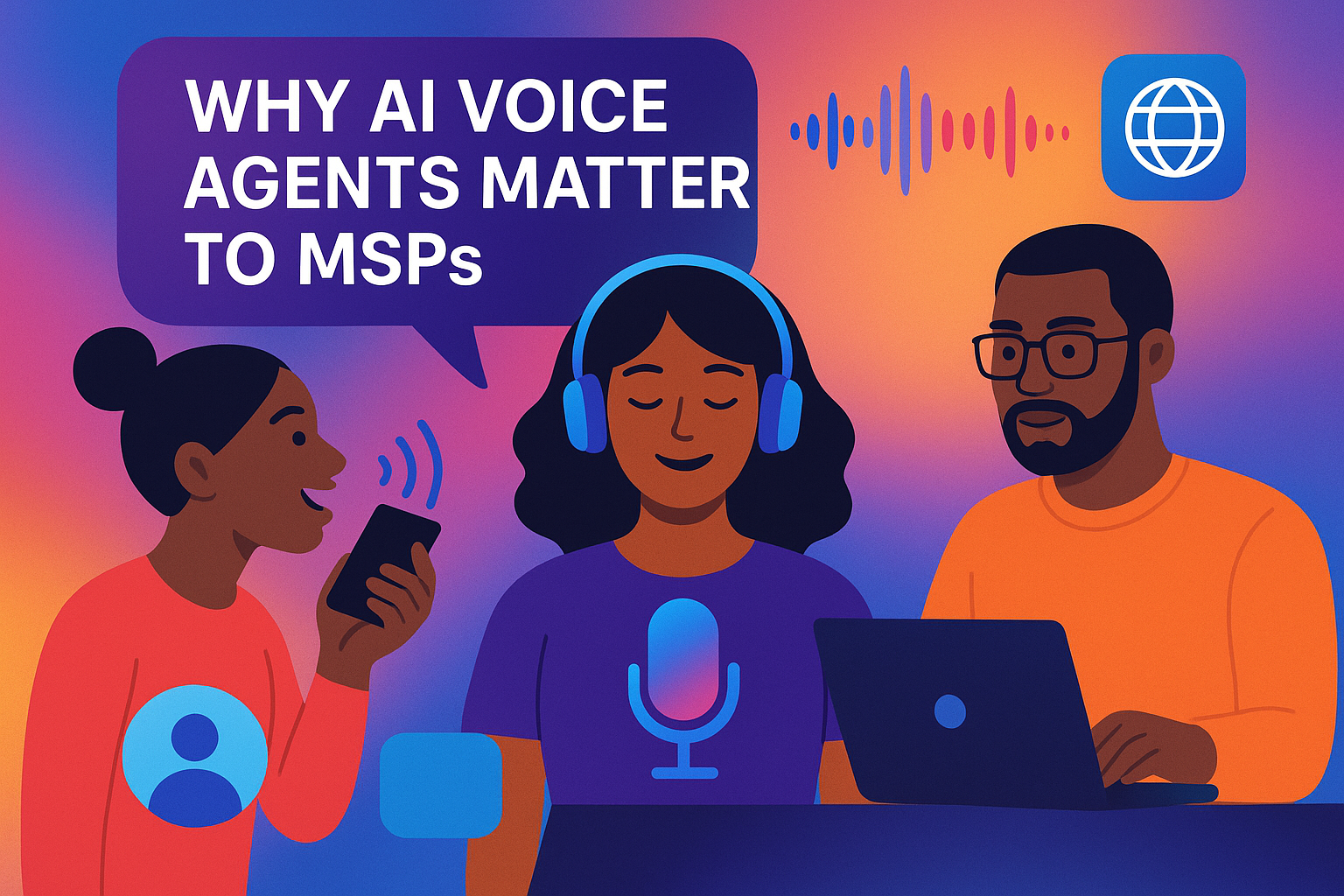
If you’re an MSP or IT service provider, you’ve probably noticed the wave of hype around “AI agents” and “agentive AI.” It feels like everyone is suddenly using these words, but few people are giving a clean explanation of what these systems are actually supposed to do.
1. Everyone’s Talking About AI Agents — Here’s What You Actually Need to Know
Most MSPs I talk to are thinking:
-
Is this just ChatGPT with fancy branding?
-
What’s the difference between a chatbot and an AI agent?
-
How does this relate to phone systems, support intake, and real customer workflows?
The truth is: there’s something real here — and it’s going to impact how MSPs deliver voice, support, and service automation very quickly.
By the end of this article, you’ll understand agentive AI in practical terms, how it works, the problems it solves, and why it matters for voice agents.
2. What Is Agentive AI? Key Characteristics in Plain English
Here’s the best way I explain it: Agentive AI is AI with lots of hands — hands that can reach into your systems, use your knowledge, and actually get work done.
This is the key difference. Regular AI gives you answers. Agentive AI gives you outcomes. It doesn’t just talk. It acts.
Let’s break down the characteristics:
1. Goal-Oriented
Agentive AI doesn’t think in one-off prompts. You give it a goal (“handle after-hours calls”) and it manages the entire workflow.
2. Tool-Using
This is the “lots of hands” part.
Agentive AI can call APIs and interact with:
-
CRMs
-
Ticketing platforms (ConnectWise, Autotask)
-
Scheduling systems
-
Email
-
Webhooks
-
Business applications
This is where traditional chatbots fall short. They can talk — but they can’t do.
3. Context-Aware
Agentive AI remembers the conversation, the workflow step, and the goal. It maintains state. This is the part everyone overlooks — without context, AI is just guesswork.
4. Autonomous Within Guardrails
This is where my real-world philosophy comes in:
Give the agent enough freedom to solve problems, but not enough to create new ones.
The agent works independently but inside well-defined boundaries:
-
what it can do
-
what it can access
-
when to escalate
-
what topics are off-limits
-
how to handle sensitive scenarios
This is where a lot of DIY systems collapse.
3. How Agentive AI Works Behind the Scenes
Agentive AI follows a loop that’s simple to understand but powerful in practice.
1. Perceive
Takes in input — speech, text, events, alerts.
2. Understand
Uses models to interpret:
-
intent
-
sentiment
-
context
-
priority
Important: Not all AI agents use multimodal LLMs.
A lot of the tools MSPs experiment with are single-modality or text-only LLMs — and that’s why they break.
Which leads us to an important point…
Why Multimodal LLMs Matter (and Why Older Models Struggle)
A lot of partners have told me things like:
“We tried LLMs, but they were slow and confused.”
Or:
“We used some tools, but wound up with a mess and bad interactions.”
There’s a reason:
Text-only models weren’t built for real-time voice.
Multimodal LLMs — the modern ones — interpret speech, text, system state, and context together. And here’s the bottom line:
If you want an AI voice agent that doesn’t get lost, backtrack, or frustrate callers, look for multimodal LLMs. Anything else is already behind.
This is where most DIY approaches fall apart.
3. Decide
The agent evaluates goals, rules, and available tools and chooses the next step.
4. Act
This is the “hands” part:
-
open a ticket
-
route a call
-
send an email
-
check an order
-
log an update
-
escalate
-
complete the workflow
5. Learn & Improve
You tune it. You update prompts. You add guardrails. It gets better over time.
4. Real-World Applications MSPs Can Deploy Today
Let’s focus on scenarios MSPs can put into production now — especially for voice.
Voice-First Applications
1. AI Front Desk / Receptionist
Answers calls, authenticates the caller, handles the request, and only routes when needed.
Real example verticals:
-
Dental offices
-
Legal practices
-
Home services
This isn’t a chatbot — it’s a workflow executor.
2. Support Intake Agent
One of the cleanest use cases for MSPs.
The agent:
-
gathers all required fields
-
asks clarifying questions
-
attempts simple troubleshooting
-
categorizes the issue
-
writes a clean ticket
-
sends confirmation
Humans start from a complete record — not a blank one.
3. After-Hours or Overflow Agent
This is where things fall apart for SMBs.
The agent:
-
never misses a call
-
handles FAQs
-
logs everything
-
routes emergencies
-
escalates appropriately
HVAC during heatwaves. Dentists on weekends. Any business with unpredictable volume.
Non-Voice Examples (short list)
-
Inbox triage
-
Alert monitoring → ticket creation
-
Weekly report summarization
-
CRM cleanup
Useful, but the voice applications are where MSPs see the highest impact.
5. Ethical Considerations (Practical, Not Preachy)
Ethics matter because bad AI interactions reflect on you.
Here’s what matters in practice:
Transparency
Callers should know they’re talking to an AI agent.
Escalation
Agents must hand off when:
-
sentiment turns negative
-
the issue gets complex
-
human judgment is required
Privacy
Avoid oversharing.
Store only necessary info.
Respect compliance rules.
Bias & Fairness
Review logs.
Tune behavior.
Never set it and forget it.
6. Development Challenges: Why DIY Agent Builds Get Fragile Fast
Every MSP hits the same walls.
1. Integration Complexity
PBX + CRM + ticketing + calendars + APIs = a lot to maintain.
2. Edge Cases Everywhere
Real-world call flows don’t follow scripts. This is where things fall apart.
3. Ongoing Tuning
Prompts, workflows, rules — all evolve.
4. Support Burden
DIY builds create long-term pain.
The reality is:
A delay in launching an AI voice agent delays customer outcomes — but a rushed DIY build creates years of support overhead.
7. Why Agentive AI Matters for MSPs
Here’s why MSPs should care:
1. It turns AI from“cutedemo” into a working teammate.
A teammate with hands.
2. It creates new services to sell.
AI-powered call handling
Support automation
After-hours coverage
3. It improves customer outcomes.
Fewer missed calls
Better documentation
Faster response times
4. It frees your team to do higher-value work.
8. The Link to AI Voice Agents
Here’s the bridge:
AI voice agents are the voice-first expression of agentive AI — built for real-world business workflows.
They don’t just answer calls. They execute tasks.
Routing. Ticketing. Authentication. Scheduling. Escalation. This is the natural evolution of UCaaS.
Platforms like NetSapiens paired with tools such as Agent Studio now make it possible for MSPs to deploy agentive AI voice agents in minutes — with the guardrails, integrations, and performance that real customer environments demand.