_FBlogo_red.png)



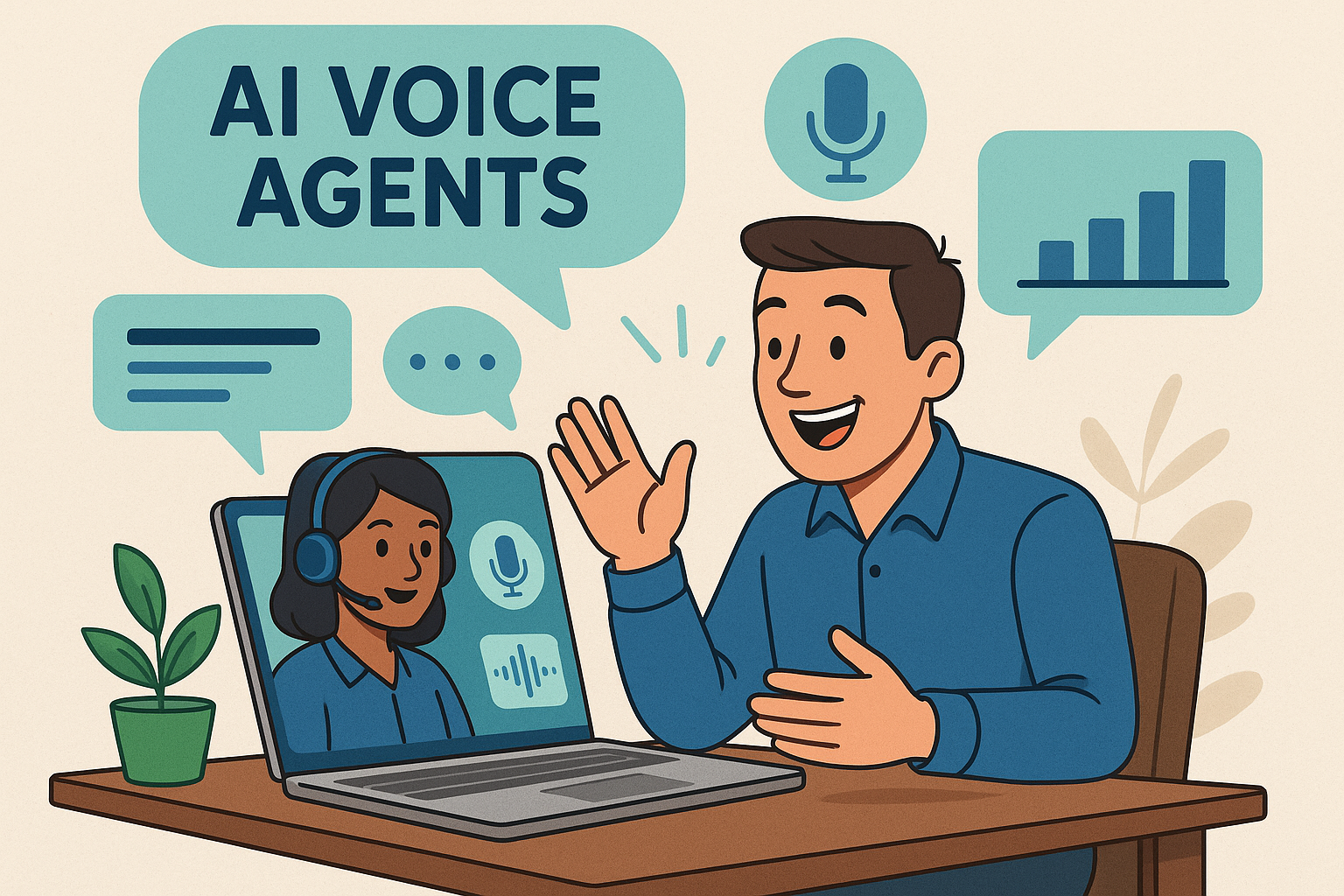
AI voice agents have quickly emerged as one of the most important new capabilities in the modern communications stack. MSPs are hearing about them from vendors, analysts, and increasingly from their own customers. Yet for many service providers, the category still feels vague: What exactly is an AI voice agent? How does it work? Where does it fit within a PBX or UCaaS environment? And what problems does it actually solve?
This guide provides a clear, practical explanation—designed for MSPs, IT service providers, and organizations that manage telephony and customer experience for small and midsize businesses.
By the end, you will have a grounded understanding of the technology, the real business use cases, and why AI voice agents are becoming an essential part of the MSP toolkit.
 What Is an AI Voice Agent? A Clear Definition
- Talks like a human
- Understands like a human
- Takes action faster and more accurately than a human, because it is integrated into the systems where work actually happens
Not an IVR
Unlike “Press 1 for sales” menus, AI voice agents do not require rigid caller navigation. They accept open-ended speech and determine intent automatically.
Not a simple chatbot
Chatbots can answer questions. AI voice agents answer questions and complete tasks—such as looking up records, creating tickets, routing calls, or scheduling appointments.
Not voicemail or call recording
Traditional call handling captures information after the fact. AI voice agents handle the interaction in the moment and take immediate action.
The result is a more capable, always-on, context-aware first point of contact for incoming calls.
How AI Voice Agents Work (High-Level Overview)
AI voice agents combine several technologies into one coordinated workflow. MSPs do not need to understand the underlying machine learning math; what matters is how the components work together.
The flow is generally:
1. Speech Recognition
Caller audio is converted into text. This is the foundation for understanding.
2. Language Understanding
Modern multimodal LLMs interpret what the caller is asking, detect sentiment, and determine the intent and next steps. These models understand context far more naturally than previous generations.
3. Agent Logic or “Brain”
Based on caller's intent, the agent decides what to do:
-
Ask clarifying questions
-
Look up information
-
Log a support ticket
-
Trigger a workflow
-
Route the call to a specific person or queue
4. Actions and Integrations
AI voice agents can interact with:
-
PBXs (NetSapiens is a common example, but not a requirement)
-
CRMs
-
Ticketing systems like ConnectWise and Autotask
-
Scheduling platforms
-
Line-of-business applications
-
Webhooks and APIs
5. Intelligent Handoff to Humans
When issues exceed the agent’s scope—especially during high emotion or complex troubleshooting—the system cleanly escalates the call with full context.
Multimodal LLMs now make the conversational experience smoother, more adaptive, and more aligned with customer expectations.
Practical Use Cases MSPs Can Deploy Today
AI voice agents are no longer experimental. MSPs are implementing them to solve very specific, high-frequency challenges in SMB environments.
Below are the scenarios where deployment is easiest and value is clearest.
1. After-Hours and Overflow Handling
Businesses struggle to maintain coverage during evenings, weekends, and high-volume periods. AI voice agents ensure every call receives immediate engagement.
Capabilities include:
-
Greeting and triage
-
Collecting caller details
-
Identifying urgent cases
-
Creating structured tickets
-
Alerting on-call staff
-
Routing escalations based on rules
Vertical examples:
Dental practices handling emergencies, HVAC companies dealing with weather-driven spikes, legal offices capturing new client inquiries after hours.
2. Tier 1 Support Intake
Much of Tier 1 support involves repetitive information gathering and basic troubleshooting. AI voice agents can reliably execute this workflow:
-
Identify the caller and business
-
Gather the required support fields
-
Ask the standard diagnostic questions
-
Pull knowledge base steps
-
Summarize findings
-
Create a ticket with complete documentation
Human technicians begin work with a fully prepared ticket instead of spending several minutes gathering context.
3. FAQ and Informational Requests
Many SMB calls revolve around basic fact retrieval:
-
Hours of operation
-
Directions
-
Password resets
-
Order status inquiries
-
Policy clarifications
AI voice agents can provide consistent, accurate responses instantly—no wait times, no interruptions to human staff.
4. Sales Intake and Lead Qualification
Businesses often miss revenue because incoming calls go unanswered. AI voice agents capture:
-
The caller’s information
-
The reason for their call
-
Relevant qualification details
-
And, when appropriate, automatically schedule appointments or route warm leads
This is especially valuable for service businesses where every new prospect counts.
Operational Problems AI Voice Agents Solve for MSPs and SMBs
The business value of AI voice agents comes from solving long-standing challenges that affect both MSP operations and SMB customers.
1. Missed Calls and Lost Opportunities
Every missed call can represent lost revenue or a damaged customer relationship. AI voice agents ensure immediate engagement.
2. Overloaded Staff
Receptionists, dispatchers, and Tier 1 technicians often spend time on low-value, repetitive tasks. Automation frees them to focus on issues requiring human judgment.
3. Coverage Expectations
Modern customers expect businesses to be reachable 24/7. Staffing for constant coverage is costly and impractical. AI agents provide consistent service at all hours.
4. Complexity of DIY AI Implementations
A concern voiced by many MSP partners:
“We tried several tools, but everything felt overly complex. We kept running into walls we didn’t even know were there.”
General-purpose AI tools are not designed for integrated call flows or telephony-grade CX. The result is often fragile implementations that fail during real customer interactions.
5. Safeguarding Customer Experience
AI voice agents must know when to stop, escalate, or hand off. Without sentiment detection, guardrails, and routing logic, callers quickly become frustrated. Poor implementation leads to poor CX—and MSPs bear the blame.
 Where AI Voice Agents Fit in the Modern Communications Stack
AI voice agents do not require a specific PBX or UCaaS platform. They operate as an intelligent front door that routes into:
-
NetSapiens
-
3CX
-
Asterisk-based systems
-
Broadsoft
-
Metaswitch
-
Or virtually any modern PBX with clean call routing
On the application side, they integrate with the tools SMBs and MSPs already use:
-
CRMs
-
Help desk platforms
-
Scheduling and practice management software
-
Databases and ERP systems
-
Web-based business tools
-
APIs and automation platforms
This flexibility allows MSPs to deploy AI voice agents across diverse customer environments without requiring wholesale infrastructure changes.
The Business Case: Why MSPs Should Pay Attention Now
Beyond the technical capabilities, AI voice agents provide significant strategic and financial advantages to MSPs.
1. Real Internal ROI
AI offloads repetitive tasks, improves ticket quality, reduces after-hours staffing pressure, and minimizes interruptions—all of which increase operational efficiency.
2. New Revenue Opportunities
MSPs can offer AI voice agents as a value-added service on top of existing UCaaS or voice solutions. This transforms the provider from a “dial tone reseller” into a partner that delivers measurable business outcomes.
3. Stronger Differentiation
AI-enabled call handling positions MSPs ahead of competitors who rely only on traditional IVRs or voicemail, particularly in markets where SMBs actively seek innovation.
4. Customer Retention and Stickiness
When AI voice agents improve customer experience, the underlying voice platform becomes more indispensable. MSPs that deliver AI-enabled automation tend to see higher retention and greater engagement with their broader service stack.
Where MSPs Should Go Next
Understanding what an AI voice agent is is the first step. The next step is selecting the right approach and implementing it in a way that protects customer experience and avoids the pitfalls of DIY experimentation.
In future posts, we will explore:
-
How to evaluate AI voice agent platforms
-
Common architectural patterns
-
Best practices for routing, escalation, and sentiment handling
-
How MSPs running platforms like NetSapiens are deploying these capabilities in minutes—not months—with tools such as Agent Studio
AI voice agents are no longer experimental. They represent a meaningful evolution in how phone systems, customer service, and SMB operations function. MSPs who adopt these capabilities now will be positioned as leaders in the next era of business communications.