_FBlogo_red.png)


In our last article, we explored prompting — the art of teaching AI voice agents what to do and how to behave. But even the best prompts can only take you so far if the agent doesn’t have access to the right information.
That’s where RAG comes in.
RAG stands for Retrieval-Augmented Generation, and while the term sounds technical, the idea is simple: It’s how you help your AI voice agent remember what’s true — so it gives accurate, useful answers every time.
Key Takeaways
-
RAG connects your AI voice agents to trusted, up-to-date knowledge so they stop guessing and start giving accurate, business-ready answers.
-
For MSPs, RAG dramatically reduces “confident but wrong” responses that damage credibility with customers.
-
RAG works best alongside strong prompting, turning a generic model into a reliable, branded agent that can scale across many clients.
The Problem: Confident but Wrong
One of the most frustrating experiences customers can have with AI is when it responds confidently . . . and incorrectly.
It’s a common failure point in the AI world. The model doesn’t “know” your business, your customers, or your data. It just generates what sounds like a good answer.
That might be fine in a casual chatbot, but it’s a serious problem in a business context.
For an MSP, a bad AI response isn’t just a mistake — it’s a credibility hit. When an agent gives a customer wrong pricing, wrong instructions, or wrong policy information, it undermines the relationship that you’ve built.
The core reason this happens? Lack of context.
How RAG Fixes That
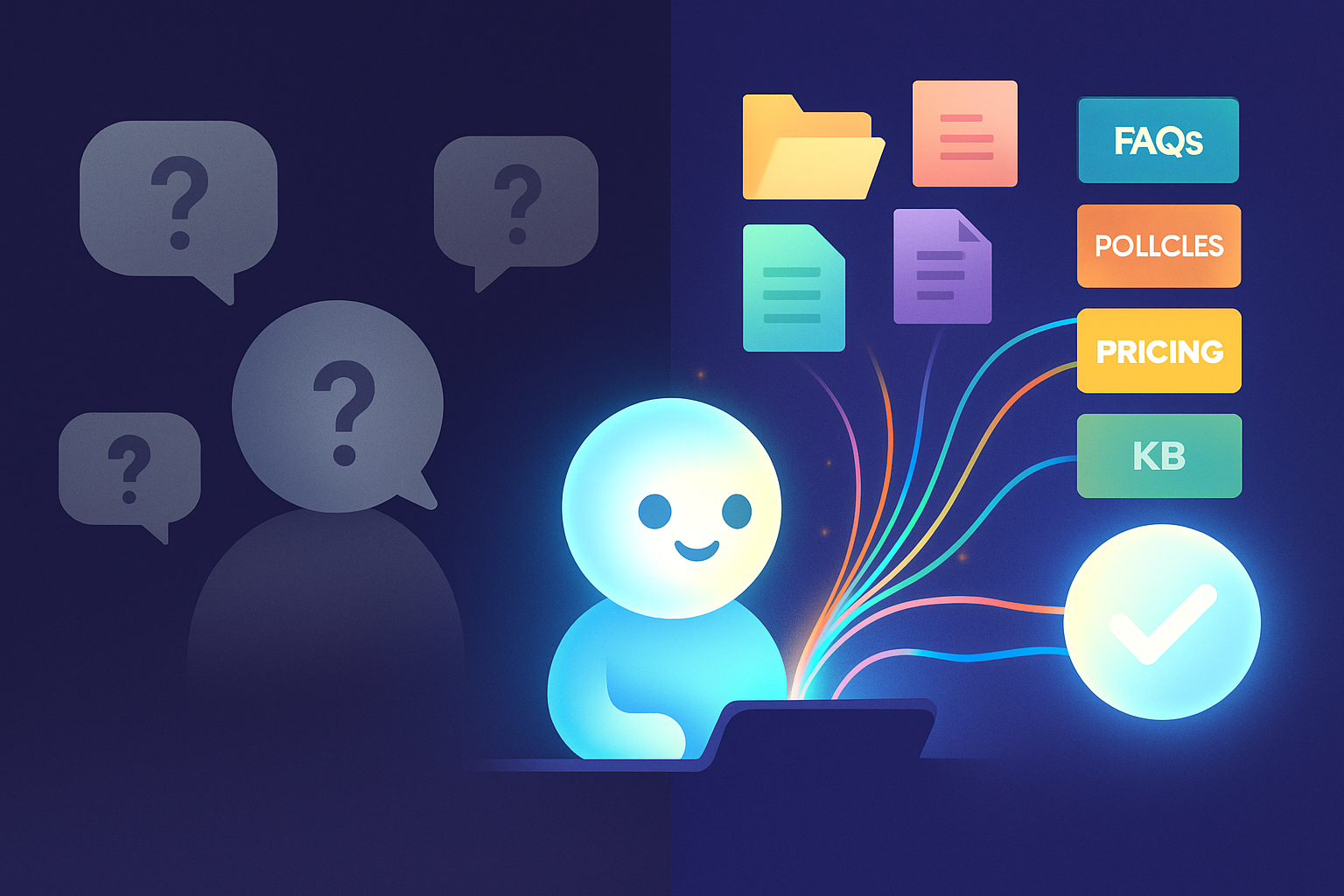
To understand RAG, imagine you hired a new technician. They’re bright, articulate, and eager to help — but they don’t know your documentation, your policies, or your customer base.
Now imagine giving them access to your internal knowledge base, FAQs, and ticket history. Suddenly, their answers improve dramatically. They’re still learning, but they now have the right reference materials to guide them.
That’s exactly what RAG does for AI voice agents.
It connects the model to your company’s trusted information sources — documents, FAQs, databases, or knowledge articles — so that when a question comes in, the AI can retrieve relevant data and use it to generate a better answer.
It’s not guessing anymore. It’s informed.
Breaking Down the Term (Plain English Edition)
Let’s unpack it simply:
-
Retrieval → The AI searches your defined information sources for the most relevant data.
-
Augmented Generation → It then uses that data to craft a natural, context-aware response.
You can think of it as the AI’s version of open-book problem-solving. Instead of memorizing every fact, it looks up what it needs — and explains it in real time.
This keeps answers current, accurate, and consistent with how your business operates.
Why RAG Matters for MSPs
As an MSP, your customers trust you to implement technology that works reliably — and that trust depends on accuracy.
When AI voice agents don’t know where to find the truth, they improvise. When they have access to structured, approved knowledge, they deliver consistently better results.
With RAG, your AI voice agents can:
- Pull real data from your customers’ systems instead of making assumptions.
- Reference up-to-date policies, prices, and procedures.
- Reduce errors and misinformation that frustrate end users.
- Scale easily — one knowledge source can power multiple agents across accounts.
For MSPs serving SMB clients, that means you can deploy helpful, trustworthy agents that sound professional without needing to manage complex machine learning pipelines.
A World Without RAG (And Why It Fails for AI Voice Agents)
Without RAG, even a well-prompted AI voice agent is like a talented employee working from memory.
It can sound convincing, but it’s missing facts. It might say: “Sure, your business plan includes unlimited data.” When, in reality, the customer’s account is capped.
Every wrong answer erodes confidence — and eventually, the entire idea of AI automation gets blamed. When MSPs choose tools that don’t support context and retrieval, they risk creating AI experiences that feel more like a guessing game than a conversation.
RAG in Action: Turning Talk into Understanding
Here’s what happens when RAG is done right:
- The customer asks a question: “Can I upgrade my plan mid-cycle?”
- The agent retrieves the relevant section from a policy document.
- It answers accurately, clearly, and conversationally: “Yes, you can. The new plan takes effect immediately, and your next invoice will reflect a prorated adjustment.”
No searching, no escalation — just the right information, instantly.
That’s the kind of experience that builds confidence in automation — and in you as the MSP who delivered it.
The Big Picture: RAG + Prompting = Real AI Voice Agent Success
Prompting teaches your agent how to think. RAG gives it something worth thinking about.
Together, they turn a generic AI model into a knowledgeable, reliable voice for your business and your customers.
When you combine clear instructions with accurate context, you get agents that:
- Sound natural and human.
- Stay accurate and consistent.
- Resolve issues faster.
- Keep customers happy and engaged.
That’s the foundation of successful AI deployments — and the future of how MSPs deliver value in a voice-driven world.
“AI doesn’t fail because it’s too smart — it fails because it doesn’t know enough. RAG is how you fix that.”
End of Series Summary
This concludes our three-part series on Making AI Agents Work for MSPs.
- Part 1: Why AI agent success depends on understanding real conversations.
- Part 2: How prompting shapes the way AI agents think and behave.
- Part 3: Why RAG provides the knowledge and context that make AI truly useful.
Together, these ideas form the foundation for what’s next: AI agents that don’t just talk — they listen, understand, and help.