_FBlogo_red.png)


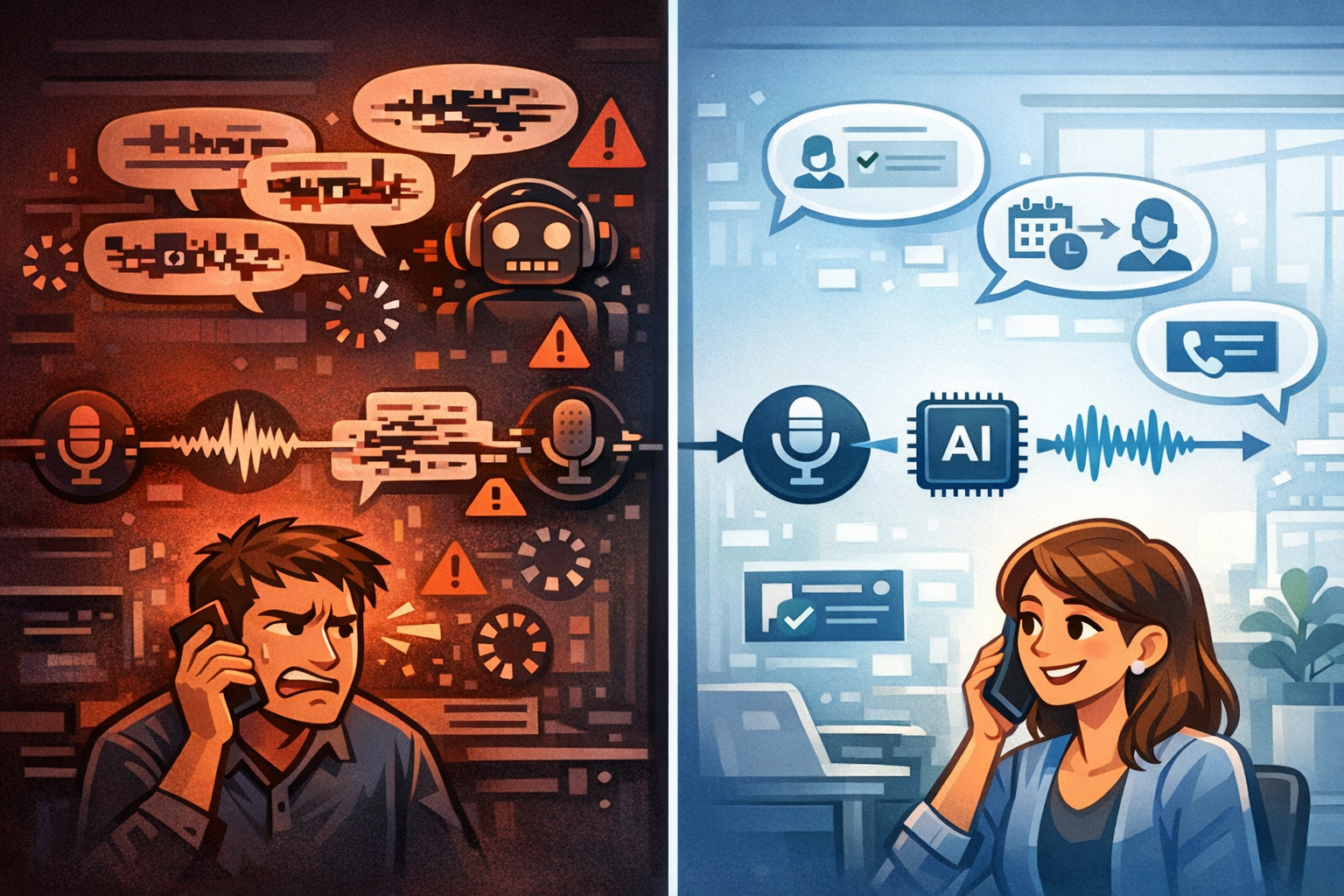
For MSPs and their customers, the question is no longer whether to use voice AI — it’s whether the AI can provide natural conversations, grounded answers, and real actions during a call.
AI agents perform well in controlled environments where agents follow predetermined scripts and callers follow predefined rules without interrupting. But live customers don’t behave that way.
That’s why the moment you put these AI voice agent platforms into real-world conditions — calls, noise, actual customers — the experience starts to break. Real customers interrupt, hesitate, change subjects, switch languages, or ask questions outside the script.
We tested multiple AI voice agent platforms in real environments and got the same result across the board: agents gave incorrect answers, talked over callers, sounded robotic, and lagged behind the conversation leading to awkward pauses.
So here’s the question you should be asking: “Is there a voice AI agent platform that works in real-world environments?”
The answer is yes: RingLogix Agent Studio. Our platform is built to handle the messy nature of real phone conversations — interruptions, corrections, and callers who don’t follow a script. The platform was designed around the realities of MSP businesses: limited time, small teams, and the need to deliver reliable customer experiences.
Key Takeaways
-
Most AI voice agent platforms fail because of architecture — not capability
-
Pipeline systems introduce lag, errors, and broken conversations
-
Real-world failures include interruptions, pauses, robotic speech, and hallucinations
-
Agent Studio is a speech-native AI voice agent platform built for real-time conversations
-
Your customers don’t want AI — they want outcomes
Why Most AI Voice Agents Fail in the Real World
On paper, the promise is simple: AI voice agents that sound human and that handle real work such as answering calls, capturing details, completing tasks, routing and transferring calls, and escalating when needed. That’s what AI voice agent services for businesses are supposed to deliver.
In reality, most don’t. When we tested AI voice agent platforms in production, they all had similar problems:
-
Execution speed and speech pacing weren’t consistent
-
Conversations felt broken as agents talked over callers or had awkward pauses
-
Voices sounded robotic even with smart LLMs
-
Call routing felt bolted on/not built to be a native part of a phone system
-
Answers are confident — but wrong
This comes down to how these systems are built. A voice agent that works in production cannot be a chatbot wrapped in a call. But most AI voice agent platforms today are exactly that.
The Architecture Problem
Most platforms rely on pipeline systems: speech → transcription → LLM → speech. That’s where the conversation breakdown starts. Here’s what we learned about platforms with pipeline systems and the problem this architecture creates.
Transcription Adds Lag and Loses Context
When you add lag, you add errors and you lose the conversational signals (timing, tone, flow) through text chunking. In voice, milliseconds matter. Even small delays break the experience. And once that’s gone, the conversation feels off.
Turn-Taking Breaks
Turn-taking breaks degrade when voice activity detection is weak or overly dependent on chunked text. That’s why agents interrupt you or pause too long. Either way, it feels unnatural.
Performance Isn’t Stable
Shared infrastructure makes performance unpredictable.
Knowledge Systems Not Designed for AI Cause Hallucinations
If you’re not using a knowledge system designed for AI, your hallucination risks will be extreme. When systems mix data, agents will guess, fill gaps, and get it wrong.
The Reality
Most AI voice agent service providers are trying to build real-time voice agents using text-native components that weren’t optimized for real-time. That’s the root of the problem.
How Agent Studio Is Built Differently
We didn’t try to fix the pipeline. We replaced it. And we built something better: an AI voice agent platform that is speech-native for real-time conversations and practical deployments.
Conversations That Actually Feel Natural
Audio Goes Directly into the Model
We created an adapter for our multimodal LLM that allows the model to ingest audio directly. No transcription. No lag from conversion. You keep tone, cadence, and intent.
Dedicated Infrastructure Per Call
We actually dedicate GPU resources to each call for the entire duration. No variability. No performance swings. Just consistent conversations.
Multi-layer Voice Activity Detection (VAD) for Real Turn-Taking
We designed the Agent Studio agents to provide turn-taking that feels natural by using VAD to determine:
-
Are you still talking?
-
Did you pause?
-
Are you done?
That’s what makes conversations feel human.
Tools That Turn Conversations into Action
Using tools known as API integrations, Agent Studio agents can interact with the systems your customers already use. That means an agent can open or update support tickets, pull customer account data, trigger workflows, schedule appointments, update records in external systems, and more.
This is where Agent Studio becomes powerful because the agent isn’t just answering questions anymore. It’s actually doing real work inside real systems.
Agent Studio supports:
-
Built-in tools (routing, transfers, actions)
-
Custom tools (API integrations)
-
Workflow platforms (Zapier, Make, n8n)
Knowledge That Stays Accurate
Agent Studio builds the knowledge base — in the form of PDFs, knowledge-based articles, and other information very specific to your customers’ business — using a Retrieval-Augmented Generation (RAG) system backed by a vector database.
The voice AI agent can retrieve relevant information from documents and use it to answer questions in real time. Which means your agent isn’t guessing; it’s referencing actual company data. That’s how you reduce hallucinations.
Native PBX Experience
Unlike many AI solutions that rely on external phone routing, Agent Studio integrates directly with the phone system. Because it’s fully native, it behaves just like a any other PBX user and can:
-
Route calls directly
-
Dial by extension
-
Add to queues and attendants
-
Use standard routing rules
No workarounds. No external systems.
Your Customers Want Real Outcomes — Not AI
This isn’t about AI hype. It’s about whether your voice AI agent actually works when a real customer calls.
What we saw in the market was clear: most AI voice agent platforms weren’t built for real-time conversations — they were stitched together from systems that introduce lag, break turn-taking, and create inconsistent experiences.
That’s why you get awkward pauses. That’s why you get interruptions. That’s why you get answers that sound confident — but are wrong.
Agent Studio was built to fix all of that — by starting with the right architecture, not layering over the wrong one. We took a different approach — by making Agent Studio speech-native, real-time, and built for production from the start.
Because at the end of the day, your customers don't want AI; they want outcomes. And results only happen when the conversation works.
See What Makes Agent Studio Different
👉 Book a Demo
What is a voice AI agent?
A voice AI agent is a virtual assistant that can participate in live calls, answer questions, capture details, complete tasks, and route or transfer calls in real time.
Why do most AI voice agent platforms fail?
Most fail because they rely on transcription pipelines, shared infrastructure, and weak voice detection — leading to latency, broken conversations, and inaccurate responses.
What makes Agent Studio different from other AI voice agent platforms?
Agent Studio is a speech-native AI voice agent platform that processes audio directly, uses dedicated infrastructure, advanced VAD, and RAG knowledge systems to deliver real-time conversations.
What can AI voice agent services for businesses do?
They can answer calls, capture details, complete tasks, create tickets, route calls, and integrate with business systems like CRMs and help desks.
Are AI voice agents ready for real-world use?
Yes — but only when built with real-time, speech-native architecture designed for production environments.