_FBlogo_red.png)



If you're a NetSapiens provider, chances are you're already fielding questions about AI voice. Customers want to know if their phone system can handle it. Prospects are asking whether you offer it. And somewhere in the back of your mind, you're wondering whether the answer you give today will cost you a deal tomorrow.
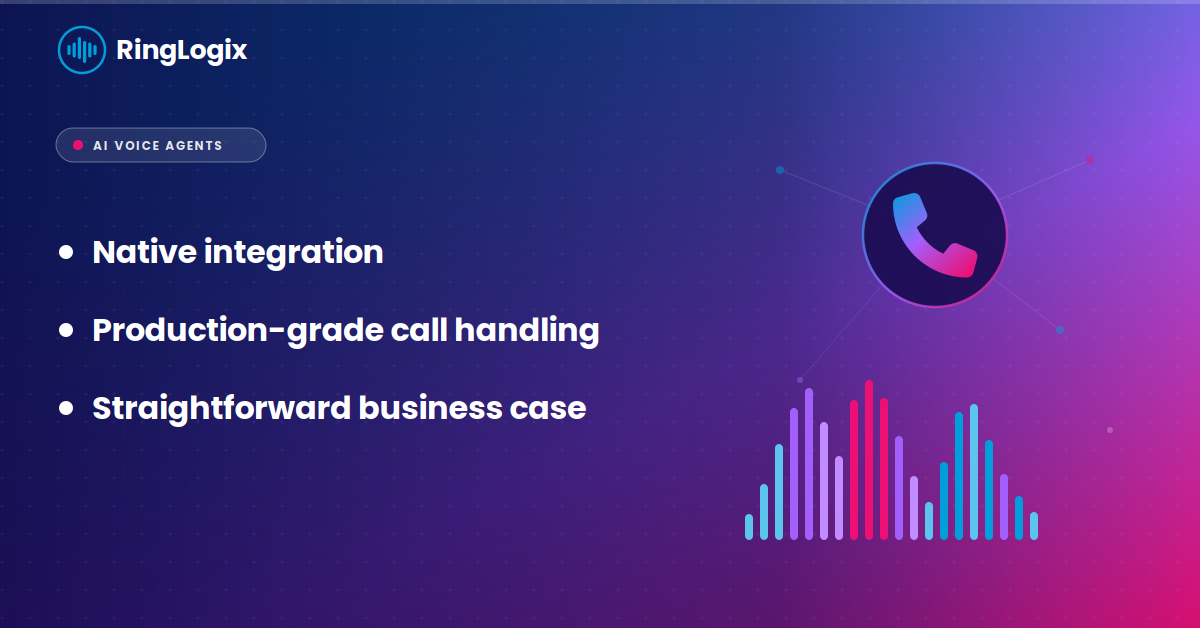
The truth is that FlowbotAI for NetSapiens is already a working reality. The integration is native. The call handling is production-grade. And the business case for adding it to your offering is straightforward once you understand how it actually fits. Let me walk you through it.
Key Takeaways
-
FlowbotAI integrates natively inside the NetSapiens PBX, no external overlay required.
-
Audio goes directly to the LLM, eliminating the transcription latency that breaks most AI voice platforms.
-
Full call handling support: transfers, DTMF (Dual-Tone Multi-Frequency), outbound calling, RAG knowledge, and live integrations out of the box.
-
Partners are seeing 70% to 80% markup on cost at premium price points.
-
If you already manage the communications stack, adding FlowbotAI is the natural next line item.
FlowbotAI for NetSapiens Versus Other AI Voice Platforms
Many AI voice agents fail in production environments because of architecture and integration depth. Those are the two areas where FlowbotAI is built differently.
Most AI voice platforms have an architecture built on a pipeline. Audio comes in, gets transcribed, the transcript goes to the language model, the model generates text, that text gets converted back to speech. Every one of those handoffs adds latency. By the time it all stacks up, you're looking at 500 milliseconds or more of variance on every single turn. In text, half a second is nothing. In voice, it's the awkward pause that makes a caller think the call dropped.
To avoid these problems, FlowbotAI takes a different approach. The platform uses a multimodal AI architecture: audio goes directly into the large language model without a transcription step in between. That removes a major source of latency that pipeline-based AI voice systems carry on every single turn. Pair that with dedicated GPU per call slot and 32 milliseconds voice activity detection sampling, and the result is an agent that responds the way a person does, not with the half-second delay that tells a caller something is off.
Another key difference between FlowbotAI and other voice AI platforms is integration. Providers who want to understand what makes a voice AI platform worth offering at the channel level should ask themselves whether the integration is native to the PBX or external to it.
External means the AI voice system sits outside your PBX and routes calls around your communications environment rather than through it. Most AI voice systems sit outside the PBX, and this creates added complexity and added failure points, so when something breaks, the troubleshooting spans two systems.
Rather than sitting outside your phone system, FlowbotAI provisions as a native user directly inside your PBX. It receives calls through the same dial plan every other extension uses and transfers calls the same way an extension would. The call stays inside the stack you already control from the moment it arrives to the moment it resolves.
For NetSapiens providers, that distinction matters. You are not introducing a foreign system that requires separate routing infrastructure or creates a second platform your team has to manage. FlowbotAI is built for real production environments and lives inside the stack you already run.
What This Means for NetSapiens Providers
Because of the way it’s built and integrated, FlowbotAI for NetSapiens supports:
Call handling: Cold and warm transfers, DTMF inputs, outbound calling initiated by the agent, and mid-call agent updates. If a caller presses a number for a specific department, the agent handles the logic and routes accordingly or escalates to a live rep on a warm transfer without dropping the call.
Knowledge and integrations: The RAG knowledge system uses a vector database with collections the agent queries mid-call. Native integrations are live with HubSpot, Zendesk, Calendly, Autotask, and Halo. Workflow automation connects through Zapier, Make.com, and N8N. The architecture behind a retrieval-based knowledge system is what separates an agent that answers calls from one that actually resolves them.
Testing: Agents can be tested inside the portal before they ever touch a live call. That is not a small thing operationally. Deploying an untested agent on a customer's inbound line is how you lose a customer. In-portal testing means you know what the agent does before it does it.
Add Value by Offering FlowbotAI for NetSapiens
Here's what the numbers show: voice minutes have been declining for a decade. Chat, SMS, ticketing portals, and self-service tools pulled conversations away from the phone. Every year, the revenue per seat compressed a little more.
AI voice is reversing that trend, and it is doing it at price points that bear no resemblance to the wholesale minute market. RingCentral's AI receptionist runs at $59 per month per customer. Nextiva sits at $99 per month per 100 interactions. Partners deploying white-label FlowbotAI are seeing 70% to 80% markup on cost. This category is priced like a premium business communication service because it functions like one.
The market numbers back up the growing SMB demand for AI voice. Business adoption of AI voice agents grew 340% between 2023 and 2026, and 80% of businesses plan to have AI-driven voice technology integrated into customer service by the end of this year.
For a NetSapiens provider, the timing question is worth taking seriously. If you are managing the communications stack for a customer, adding an AI voice agent is a direct extension of what you already deliver. The infrastructure relationship is already there. The trust relationship is already there. The billing relationship is already there. Adding FlowbotAI means capturing a line item that, if you wait, someone else will capture first.
Getting on the bill through hosted voice was step one. Staying irreplaceable by offering AI voice is step two.
When you offer white-label FlowbotAI, it operates as your platform, not ours, so providers running NetSapiens deployments can integrate FlowbotAI directly and include it in their service offering under their own brand. This means your customers interact with an AI voice agent that reflects your brand, your configuration, and your support relationship. RingLogix runs the infrastructure. You own the customer.
See how FlowbotAI agents get built and deployed inside a real production environment: Book a Demo
FAQ: FlowbotAI for NetSapiens
What is FlowbotAI for NetSapiens?
FlowbotAI for NetSapiens is a white-label AI voice agent platform that integrates natively with NetSapiens-based communications environments. The agent provisions as a native user inside the PBX, routes calls through the existing dial plan, and handles voice interactions without external routing infrastructure. NetSapiens providers can deploy FlowbotAI as a branded service under their own offer.
Can NetSapiens providers offer FlowbotAI?
Yes. NetSapiens is a supported and compatible environment for FlowbotAI. Providers running NetSapiens deployments can integrate FlowbotAI directly into their existing platform and offer it under their own brand. The agent registers as a native PBX user, which means no separate call routing infrastructure is required.
How does FlowbotAI fit into a NetSapiens environment?
FlowbotAI integrates with NetSapiens as a native UCaaS integration. The AI agent provisions as a user inside the PBX and receives calls through the existing dial plan. It supports cold and warm transfers, DTMF inputs, outbound calling, and mid-call agent updates. All call handling occurs within the communications environment the provider already manages, with no external overlay required.
Why should NetSapiens providers care about FlowbotAI?
AI voice is generating revenue at premium price points in a category that is growing fast. Providers who already manage the communications stack for their customers are naturally positioned to add AI voice without introducing a foreign platform. FlowbotAI fits natively into the NetSapiens environment, which lowers deployment friction and keeps the customer relationship intact. Partners are seeing 70% to 80% markup on cost, at monthly price points that meaningfully improve per-customer revenue.