_FBlogo_red.png)



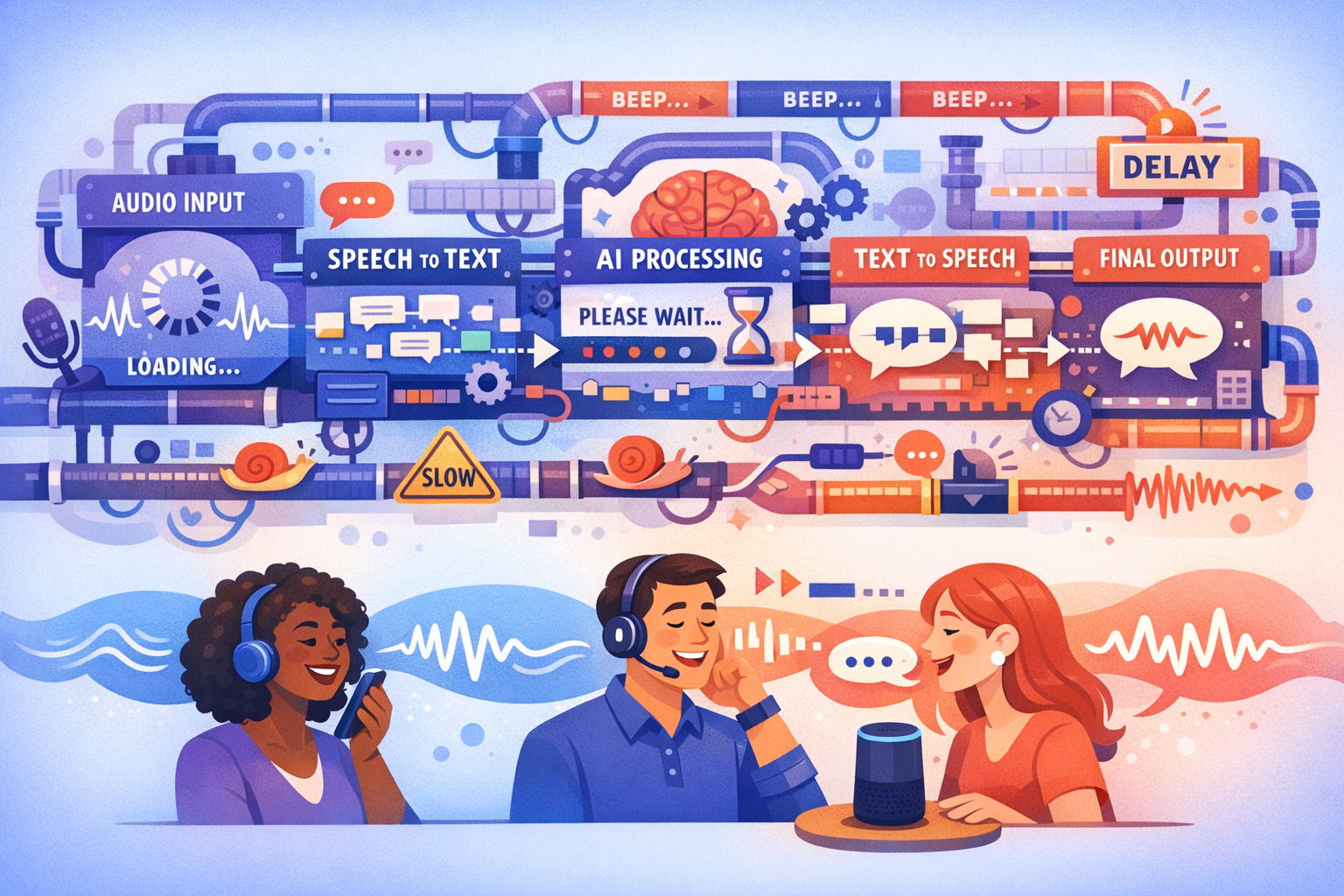
What causes latency and inconsistency in Voice AI?
Most voice AI systems rely on a multi-step pipeline that introduces delay, removes conversational signals, and creates inconsistent performance.
Once you recognize that voice AI feels slightly off, the next step is understanding why. And this is where things start to come into focus.
After testing multiple platforms, a pattern begins to emerge. The same types of delays show up. The same pacing issues appear under similar conditions. The same inconsistencies surface during real-world usage.
That kind of repetition usually points to something deeper than implementation differences. It points to architecture.
Key Takeaways
-
Most voice AI systems rely on pipeline-based designs that introduce delay and reduce conversational quality.
- The use of transcription and chunk-based processing disrupts natural interaction, while shared infrastructure introduces variability.
-
These are not isolated issues — they are structural. And addressing them requires a different approach to how voice systems are built.
The Pipeline Most Systems Rely On
At a high level, most voice AI platforms are built around a similar sequence of steps. Audio is received, converted into text, processed by a language model, and then converted back into speech. This loop continues throughout the duration of the conversation.
Individually, each step is logical. Each component serves a purpose.
But collectively, they introduce friction.
🎥 Clip: Pipeline Architecture Explanation
Where the Friction Comes From
The first source of friction is transcription. Before the system can do anything meaningful, it has to translate audio into text. That translation takes time, and it isn’t always perfectly accurate — especially in real-world environments where audio conditions vary.
More importantly, transcription changes the nature of the input. It removes many of the subtle signals that make human conversation fluid, such as tone, pacing, and hesitation.
Then there’s the way these systems process input. Rather than interpreting speech continuously, they process it in chunks. That means the system is constantly trying to determine whether a speaker has finished talking.
If it waits too long, the response feels delayed. If it responds too early, it interrupts. Neither outcome feels natural.
The Consistency Problem
In addition to these challenges, many systems rely on shared infrastructure to process requests. This introduces another layer of variability. Performance can fluctuate depending on system load, meaning that the same interaction may feel different from one moment to the next.
In a real-time environment, that inconsistency is difficult to manage and even harder to predict.
Why This Isn’t Just an Optimization Problem
At this point, it might seem like these issues could be solved with better tuning or faster components. But the reality is that these limitations are tied to the structure of the system itself.
You’re still moving through multiple steps. You’re still converting between formats. You’re still relying on processes that weren’t designed for real-time interaction.
And that’s why improvements tend to be incremental rather than transformative.
What Actually Needs to Change
To create a truly natural voice experience, the system has to be designed with voice as the primary input, not as an adaptation layer.
That means working directly with audio rather than relying on transcription as an intermediary. It means preserving conversational signals instead of stripping them away. It means handling turn-taking in real time rather than inferring it from chunks of processed text.
It also means ensuring that performance remains consistent across interactions, which requires a different approach to infrastructure.
At that point, you’re no longer optimizing a pipeline — you’re building a system that aligns with how voice actually works.
How to Evaluate Architecture
When evaluating platforms, it’s important to look beyond surface-level capabilities and focus on how the system is constructed. Understanding whether it is speech-native or transcription-first, how many steps are involved in generating a response, and whether performance remains consistent under load can provide a much clearer picture of how it will behave in production.
Architecture ultimately determines whether the experience holds together when conditions become less predictable.
🎥 Want to Go Deeper on Architecture?
In the full webinar, we break down these architectural differences in detail—and show what a system designed for real-time voice actually looks like.
👉 Watch the full webinar
👉 Learn more about RingLogix Agent Studio