_FBlogo_red.png)



Voice AI is supposed to feel natural. That’s the promise. Human-like conversations. Instant responses. Seamless interaction.
But when you actually use it — especially outside of a polished demo — you start to notice something isn’t quite right. There’s a slight delay before it responds. Sometimes it talks over you. Other times it pauses just long enough to feel uncomfortable. Nothing is completely broken, but the experience doesn’t feel smooth either.
Why does Voice AI feel slow or unnatural? Because voice is inherently real-time — and most AI systems weren’t built for that.
And that’s the problem. Because in voice, “almost right” is the same as wrong.
Key Takeaways
-
Voice is fundamentally a real-time medium, and any system that participates in it has to meet that expectation.
-
Small delays that seem insignificant in other channels become highly visible in voice. While demos can mask these issues, production environments expose them quickly.
-
Ultimately, the success of a Voice AI system depends less on what it says and more on how it behaves in the moment.
Voice Has Always Been Real-Time
If you’ve been in telecom for any length of time, you already understand this instinctively. Voice is one of the few communication channels where timing defines the experience. When a call comes in, it needs to ring immediately. When someone speaks, you respond right away. That back-and-forth rhythm is what makes a conversation feel natural.
The moment that rhythm breaks, people notice — but not in a technical way. They don’t think about latency or processing delays. They just feel like something is off. And once that feeling sets in, it becomes very difficult to recover trust in the interaction.
🎥 Clip: Voice Is Real-Time. AI Isn’t.
Where Things Start to Break
The challenge is that most AI systems were never designed for this kind of interaction. They were built for text, where delays are acceptable and often invisible to the user. In a chat interface, waiting a few seconds for a response doesn’t disrupt anything. In fact, it’s expected.
But when you take that same model and apply it to voice, those delays become exposed. Even a small delay — something that would go completely unnoticed in a text conversation — becomes obvious in a live exchange. And because multiple steps are involved in generating a response, those delays tend to stack on top of each other.
What you end up with is a system that works functionally, but fails experientially. It produces the right answers, just not at the right time.
Why Demos Don’t Tell the Full Story
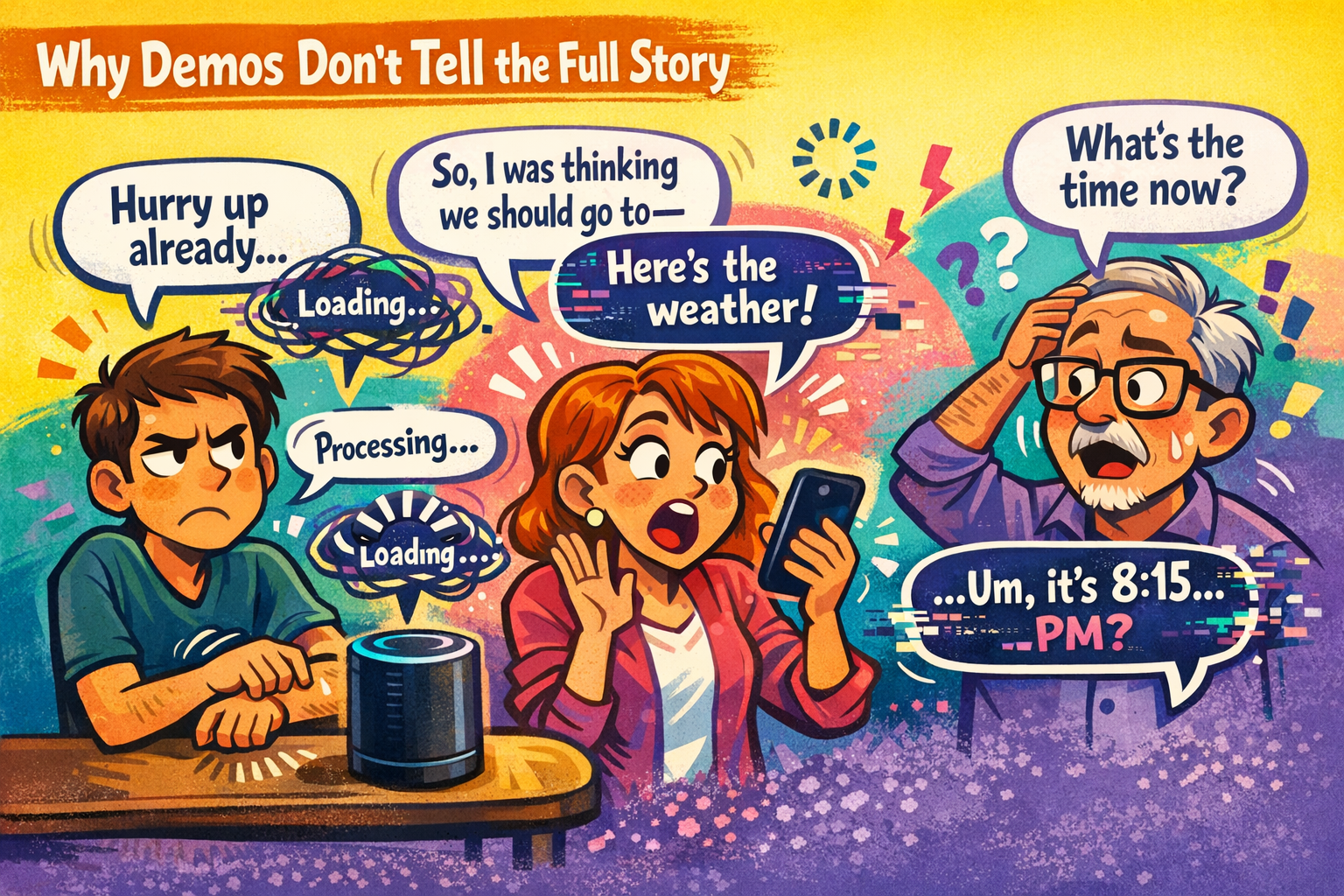
This is also why so many Voice AI demos feel impressive at first. In a controlled environment, everything behaves predictably. There’s no background noise, no interruptions, no competing system load. The interaction is clean, linear, and easy to manage.
But production environments are never like that.
Real conversations involve unpredictability. People interrupt each other. They hesitate. They speak over background noise. They ask unexpected questions. And when you layer in real usage patterns — like peak traffic times or multiple concurrent interactions — you start to see performance fluctuate.
That’s when the experience starts to break down in subtle but important ways.
🎥 Clip: Demos vs Real-World Conditions
Why This Matters More Than You Think
What makes this especially important is that users don’t analyze these issues — they react to them. They don’t think about processing time or architecture. They simply feel that the interaction isn’t smooth, and that perception changes how they engage.
They may repeat themselves. They may hesitate before speaking. Or they may disengage entirely.
Over time, those small moments add up and determine whether the system gets adopted or abandoned.
How to Evaluate Voice AI (The Right Way)
Because of this, evaluating Voice AI requires a different lens. It’s not enough to verify that the system produces correct answers. The real question is whether it behaves like a natural participant in a conversation.
That means paying attention to how quickly it responds, how well it handles interruptions, whether its pacing feels consistent, and whether the interaction feels fluid rather than mechanical. These are the factors that ultimately determine whether it will succeed in a real-world environment.
🎥 Want to See This in Action?
This topic comes directly from our full webinar, where we break down what’s actually happening under the hood — and why so many Voice AI solutions struggle in real-world environments.
👉 If you want a deeper breakdown of how to design, deploy, and scale AI voice services: Download the white paper
👉 Learn more about RingLogix Agent Studio