_FBlogo_red.png)



UCaaS providers have spent years building your business. You moved customers off legacy phone systems, got them onto hosted PBX, gave them unified communications, and kept the whole thing running. That is not a small feat.
Now AI voice is showing up in every conversation, and the question you're probably sitting with is a reasonable one: does this actually fit what I already do, or is this another vendor asking me to start from scratch?
Here's the deal. Most AI voice products are built by stitching together multiple systems — the AI lives in the cloud, your PBX lives on premises, maybe there's a separate transcription layer, a separate LLM provider, integrations everywhere. Call comes in, it bounces between all these different platforms. Latency stacks. One system goes down, the whole thing breaks. You're managing a bunch of disconnected pieces that kind of work together but really shouldn't have to.
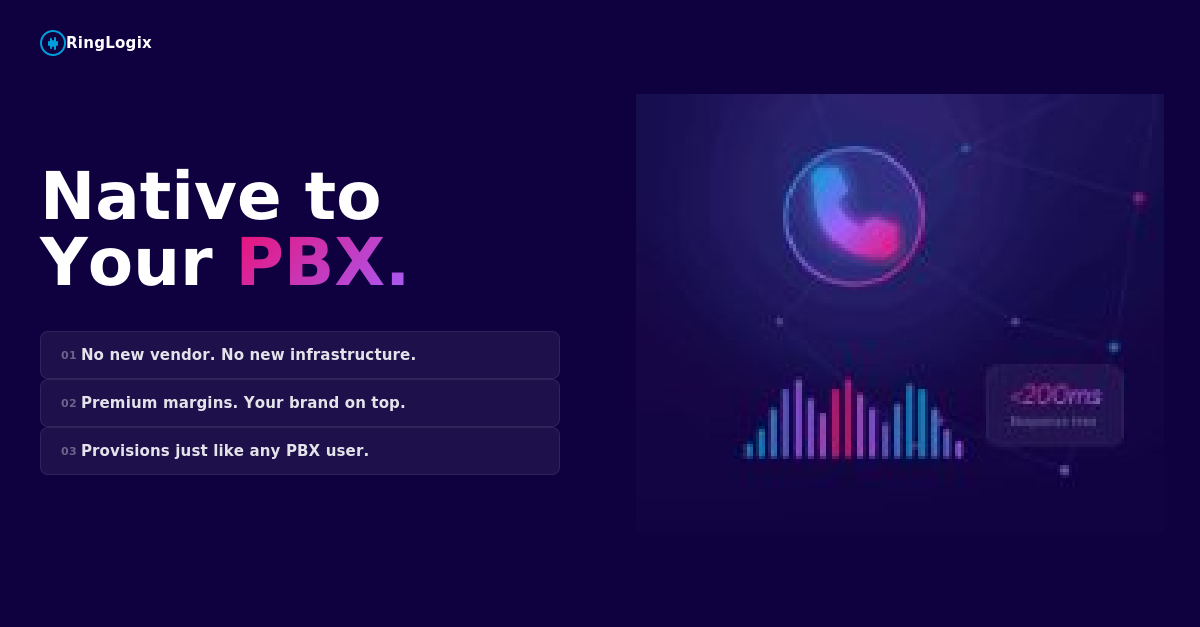
RingLogix Agent Studio doesn't work that way. It lives inside the PBX — native, not bolted on from outside. No multiple handoffs. No latency tax from bouncing between systems. The provisioning workflows you already run? They don't change. Same tools, same process.
For the SMB customers you already serve, that actually matters. Because traditional hosted voice can route calls and connect them. That's it. The second you need something intelligent — answering questions, qualifying leads, handling after-hours requests without a human on the line — it's got nothing.
That's the gap. That's what we fill. Agent Studio actually thinks. It adds AI-powered automation on top of the voice infrastructure, turning a passive call-routing system into an active, always-on business tool.
Key Takeaways
-
Agent Studio is purpose-built for channel delivery and lives inside the PBX as a native user.
- AI voice does not replace what UCaaS providers already deliver. It extends it into a new outcome category.
- Providers can white-label Agent Studio and offer it as a standalone service, an add-on, or bundled with UCaaS.
- The customers most ready to buy are already in your book of business.
-
The architecture matters. Speech-native, dedicated GPU per call, and multi-layer VAD separate Agent Studio from platforms that look good in demos but break in production.
Agent Studio for UCaaS Providers
Here's something most UCaaS providers don't think about until they're standing in front of a customer who just signed with someone else.
Your SMB customers are getting buried in inbound call volume. Appointment confirmations. Order status. Account questions. The same five calls, handled by a person who should be doing something else. That's not an SMB problem — that's a retention problem.
Agent Studio is how you fix it inside your existing stack. It provisions as a native user inside the PBX, which means it lives exactly where your UCaaS workflows already live. Provisioning, management, and support escalation all work the same way. No new infrastructure. No separate vendor relationship. No new support model to explain to your team.
What Agent Studio does is straightforward. It answers live calls, understands what the caller needs, acts inside connected business systems, and escalates cleanly when a human is required. The high-frequency, repetitive call volume that burns through staff time at every SMB you serve? That's what it handles.
So here's what that means commercially: if you have existing SMB relationships, the upsell is already sitting inside your current customer base. The infrastructure is deployed. The trust is there. This is the add-on that makes the seat you already sold worth more.
That's not a product pitch. That's math.
How Agent Studio Fits Into UCaaS
Most AI voice platforms are built on a fundamental mismatch. The AI runs on separate infrastructure. Voice runs on your PBX. You end up managing two different systems for one customer outcome — and when something breaks, there's a gap between them where the blame lives and nothing gets fixed fast.
Here's how Agent Studio is different. The agent is a native user inside the phone system. It receives calls through the same routing rules, hunt groups, and auto-attendants your UCaaS customers already have configured. When a call escalates to a human, the transfer happens inside the same system. No hand-off friction. No separate platform to point at when something goes wrong.
The architecture backs that up.
Agent Studio uses a speech-native multimodal model — audio goes directly into the model, not through a transcription step first. That matters because tone, cadence, and pacing carry intent signals that a text-based pipeline strips out entirely. Multi-layer voice activity detection at 32 milliseconds sampling handles turn-taking cleanly, so conversations don't feel like a 2009 IVR.
And Agent Studio dedicates GPU (Graphics Processing Unit) resources per each call so each gets its own reserved slice of GPU computing power — rather than all calls sharing a single pool and competing for processing capacity. This means that call performance doesn’t change whether your platform is handling one call or a hundred simultaneously.
So here's what that means for providers: you are not standing up new infrastructure. You are extending what you already manage, using provisioning and support workflows your team already knows.
I'm going to be honest with you — most of the latency and reliability problems people blame on AI voice are actually architecture problems. Build it natively, eliminate the transcription step, and dedicate the compute. The call quality follows.
That's not a positioning claim. You can see it in how fast the build and deployment process actually runs.
UCaaS Providers Sell White-label Agent Studio as Your Own
Agent Studio is a white-label platform, which means you can offer it under your own brand, with your own pricing, as a standalone service, an add-on to existing UCaaS packages, or bundled together with hosted PBX and unified communications into a single offer. The channel economics are structured to support 70% to 80% markup on cost, which puts it firmly in the premium service category, not a feature add-on priced like a seat license.
The native integrations Agent Studio supports today include HubSpot, Zendesk, Calendly, Autotask, and Halo. Workflow automation connects through Zapier, Make.com, and N8N. For UCaaS providers whose SMB customers are already using these tools, the integration story is already there. The agent does not just answer calls. It creates tickets, books appointments, updates CRM records, and routes intelligently, inside the same call.
The customers with the fastest path to value are the ones already in your book. Think about the SMBs you serve that have high inbound call volume, coverage gaps after hours, or support staff spending most of their day on the same five questions. Those are the deployments that go from signed to live quickly and produce visible results for customers without a long onboarding cycle.
If you want to understand the use cases that convert fastest, five high-impact AI voice agent use cases for MSPs and UCaaS providers lays them out clearly.
The Real AI Voice Opportunity for UCaaS Providers
Here is the thing most of the AI voice conversation misses: the opportunity for UCaaS providers is not about AI for its own sake. It is about what happens to your position with customers when you can deliver outcomes, not just access.
Traditional UCaaS is priced around access. Lines, seats, extensions, minutes. The value proposition is solid, but the margin ceiling is known. AI voice is priced around outcomes. Did the call get handled? Did the appointment get booked? Did the ticket get created? That is a fundamentally different conversation with a different price point.
For UCaaS providers, adding AI voice to the stack means something beyond incremental revenue. It means your customers start seeing you as essential to how they operate, not just how they communicate. The provider that answers inbound calls, handles after-hours volume, automates intake, and integrates with the customer's CRM is harder to replace than the one that provides dial tone and extensions.
That stickiness compounds. Every customer workflow an AI agent touches is a workflow that runs through your platform. Every integration is a deeper connection to the customer's operations. Hosted voice got you in the door. Intelligent voice is what keeps you essential.
The providers already leaning into this are not waiting for the category to mature. They are identifying one high-frequency call problem in their customer base, building a focused Agent Studio deployment around it, and replicating it. That repeatable service model is what separates the providers winning in this space from the ones still watching from the sidelines.
If you want to understand what to look for before committing to a voice AI platform, the MSP and UCaaS provider evaluation guide for voice AI platforms covers the criteria that matter in production.
Ready to see how Agent Studio fits your stack? Request a demo with a RingLogix partner growth manager.
FAQs: Agent Studio for UCaaS Providers
What is Agent Studio for UCaaS providers?
Agent Studio is RingLogix's white-label AI voice agent platform designed for channel delivery by UCaaS providers and MSPs. It allows providers to deploy AI voice agents for their SMB customers under their own brand, using a platform that lives natively inside the PBX rather than running as a disconnected third-party tool.
How does Agent Studio fit into a UCaaS stack?
Agent Studio is provisioned as a native user inside the PBX, meaning it operates within the same routing rules, hunt groups, and auto-attendants that UCaaS customers already use. It does not require separate infrastructure or a parallel support model. Providers manage it through the same workflows they use for the rest of their UCaaS stack.
Can UCaaS providers offer Agent Studio to their customers?
Yes. Agent Studio is a white-label platform built for channel delivery. Providers can brand it, price it, and package it as a standalone service, an add-on to existing UCaaS, or a bundled offer. The economics support 70% to 80% markup on cost and position it as a premium service category.
Why does AI voice matter for communications providers?
Traditional UCaaS is priced around access. AI voice is priced around outcomes. Providers who can deliver call handling, appointment booking, intake automation, and after-hours coverage move from being a communications vendor to being operationally essential. That shift produces stronger customer retention and a higher-value recurring revenue model.
What integrations does Agent Studio support today?
Agent Studio natively integrates with HubSpot, Zendesk, Calendly, Autotask, and Halo. Workflow automation is available through Zapier, Make.com, and N8N. These integrations allow agents to complete tasks in connected systems during a live call, including creating tickets, booking appointments, and updating CRM records.
What types of SMB customers benefit most from Agent Studio?
SMBs with high inbound call volume, after-hours coverage gaps, or support teams spending significant time on repetitive call types are the fastest path to value. Common verticals include dental and medical offices, legal practices, home services, and professional services firms.
How is Agent Studio different from other AI voice platforms?
Agent Studio uses a speech-native multimodal model that processes audio directly rather than converting voice to text first. It allocates dedicated GPU resources per call and uses multi-layer voice activity detection at 32 milliseconds sampling. This architecture produces more natural conversations, consistent performance under load, and cleaner turn-taking than text-based pipeline platforms.