
Last updated 8 October 2026.
A VoIP reseller program is any arrangement where a vendor supplies the phone service and you bring the customer, but the label covers four commercially different deals. Agent, affiliate, white label and wholesale differ on who owns the customer, who sends the invoice, and whether you earn commission or margin. Those three answers determine everything else.
Search this term and every result is a vendor describing its own program. That is useful for finding programs and useless for comparing them, because no vendor page explains the model it has chosen or what that model costs you. This is the comparison instead.
The four models
| Affiliate | Agent or referral | White label | Wholesale | |
|---|---|---|---|---|
| Who owns the customer | The vendor | The vendor | You | You |
| Who invoices | The vendor | The vendor | You | You |
| How you earn | One-off or short-term commission | Recurring commission on their price | Margin on your own price | Margin on capacity you resell |
| Who sets the price | The vendor | The vendor | You | You |
| Who supports the customer | The vendor | Usually the vendor | You, or the vendor as you | You |
| Effort required | Lowest | Low | Moderate | Highest |
| What you are building | A referral income | A commission stream | A service business with an asset | A telecom operation |
The bottom row is the one to read twice. An agent stream stops if the vendor changes terms or the customer churns, and it is not something you can sell later, because the contract is not yours. A white label book is a saleable asset. Those are different outcomes from what looks like the same activity.
The naming is not reliable
Vendors use these words loosely, and some programs marketed as white label are agent arrangements with a logo swap. The vendor’s own label tells you nothing. Determine the model from three answers: whose name is on the customer contract, whose name is on the invoice, and who sets the price.
What a program page never tells you
Every program page lists margin, support and a partner portal. Here is what to establish that they leave out.
- Whether the margin is protected. Ask whether the vendor sells direct in your market, and what happens if their direct sales team reaches a customer you are already working.
- What happens to the customer if you leave. In agent models the customer stays with the vendor by definition. In white label, ask specifically whether you can port numbers out and export records.
- Whether commission is perpetual. Some agent programs pay for the life of the account, some for a fixed term, some until the customer renews. This changes the value of the whole arrangement.
- Who is the provider of record. This determines regulatory and telecom tax responsibility. It is a question for your own advisor as well as the vendor, because the vendor’s answer describes their obligations rather than yours.
- Minimum commitments and how they escalate. Including what happens at renewal, which is where the terms usually tighten.
- Support boundaries. Which issues you are expected to resolve before escalating, and whether the vendor will speak to your customer under your brand.
The fourth item is the one most often waved through. Calculation, remittance and liability for telecom tax are three separate things, and a program page saying tax is handled rarely specifies which.
Choosing the model before choosing the vendor
The model should follow from what you want, and only then should you compare vendors within it.
- Choose affiliate or agent if voice is a favour you do for clients rather than a product you intend to run, and you have no wish to support it. The income is real and modest, and it will never be an asset.
- Choose white label if you want voice to be a service line with its own margin, you will support it, and you want the customer relationship to be yours. This is where most MSPs belong.
- Choose wholesale if you already run billing and provisioning, or intend to become a telecom operation in your own right.
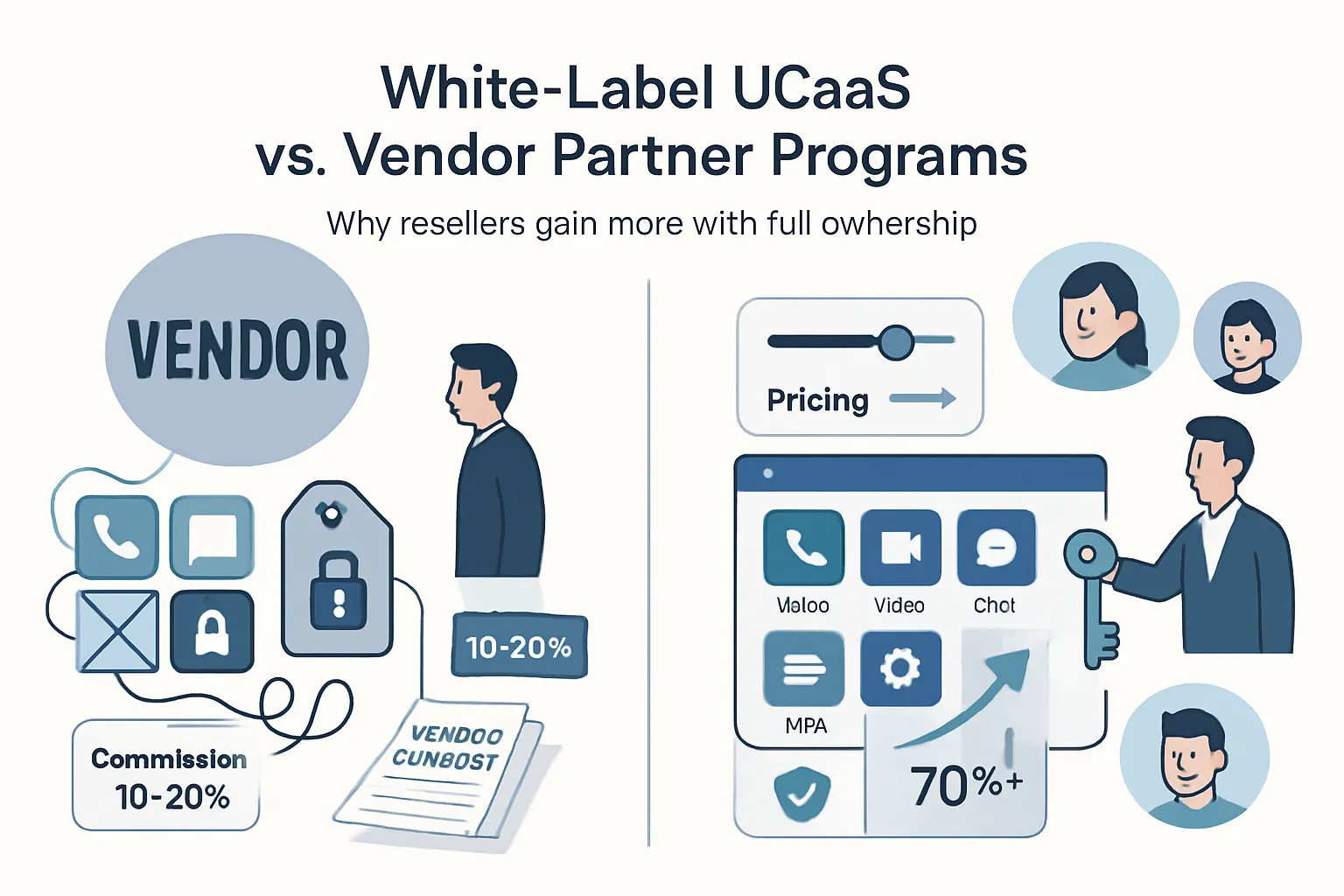
We argued the case for ownership over commission in more detail in white label UCaaS versus vendor partner programs. The short version is that commission is easier and margin is worth more, and the gap widens every year you keep the customer.
Where RingLogix is the wrong choice
We run a white label program, which means it is the wrong fit if you want commission without operational involvement. If you have no intention of supporting phones and simply want a referral fee, an agent program from any of the vendors above will suit you better and cost you far less effort. We would rather say that than sign a partner who will not sell.
Programs you will find in this market
Named because a comparison that names nobody is not a comparison. Positioning is taken from each vendor’s own public material, and the model each operates should be confirmed with them directly rather than inferred from the label.
- Intermedia markets a partner program spanning white label and agent routes across UCaaS and CCaaS.
- SkySwitch and RingLogix both position on white label for MSPs and resellers.
- VirtualPBX, OnSIP and RingByName publish reseller or partner programs aimed at a mix of agents and resellers.
- Simplicity VoIP markets its program at MSPs moving into voice.
- SIPTRUNK and SIP.US sit closer to the capacity end, which suits partners who want to assemble their own offer.
Comparing these on margin percentage alone will mislead you, because a higher percentage of a price you do not control is worth less than a lower percentage of one you do.
Frequently asked questions
What is a VoIP reseller program?
An arrangement in which a vendor provides the phone platform and network while a partner brings customers. The term covers affiliate, agent, white label and wholesale models, which differ on customer ownership, invoicing and whether the partner earns commission or margin.
What is the difference between a VoIP reseller and an affiliate?
An affiliate refers business and receives a commission while the vendor owns and bills the customer. A reseller in the white label sense buys the service, sets its own price, invoices the customer and owns the relationship. The first is a marketing arrangement, the second is a business line.
What is the difference between an agent and a white label reseller?
An agent sells the vendor’s service at the vendor’s price and receives recurring commission, with the contract between vendor and customer. A white label reseller sells under its own brand at its own price, holds the customer contract and keeps the margin. Agents carry less risk and build no asset.
How much can a VoIP reseller make?
Be wary of any single figure quoted for this, ours included. Earnings depend on the model, your pricing, seat counts and how much support you absorb, and the difference between an agent commission and a white label margin on the same customer is substantial. Model it on your own expected seat count and support cost rather than on a published example.
Do I need a licence to resell VoIP?
It depends on the model and on where you operate, and it is not a question to settle from a vendor’s program page. What determines your exposure is whether you are the provider of record to the end customer, which is exactly what changes between agent and white label arrangements. Establish that point in writing and take your own regulatory and tax advice on it.
How do I choose a VoIP reseller program?
Settle the model first, then compare vendors inside it on the terms that are hard to reverse: customer ownership, pricing control, telecom tax responsibility, support boundaries and what you can take with you if you leave. Feature lists converge across this market, and contract terms do not.
Deciding
Ask one question before any demo: in three years, do I want a commission stream or a book of customers? Both are legitimate and they lead to different programs. The mistake that costs the most is signing an agent agreement while expecting to have built something, and finding out at exit that the customers were never yours.
If the second answer is the one you want, the RingLogix partner programme sets out the terms in full, including the parts above that most program pages leave unstated.